
TRL Books » The Many Faces of Harry » Excerpt
The Many Faces of Harry: Read an Excerpt
Thomas Taylor
In the grand mythology of Harry Potter, every journey seems to begin with a train. J.K. Rowling famously conceived the boy wizard while delayed on a journey between Manchester and London in 1990, watching the English countryside blur past her window as the story of a young orphan unfolded in her imagination. But five years later, another train journey would prove just as pivotal to the series' destiny.
In 1996, a young illustrator named Thomas Taylor stepped off a train at King's Cross Station, portfolio clutched in his nervous hands. The irony was lost on him then, that he was arriving at the very station that would soon become synonymous with the magical world he was about to help bring to life. Recently graduated from art school and working in a children's bookshop in Cambridge, Thomas Taylor was making the journey to London on little more than hope and talent. He had no agent, few industry contacts, and only a handful of drawings to show for his artistic ambitions.
That train journey, taken on a leap of faith, would lead to one of the most iconic pieces of book cover art in modern publishing history and mark the beginning of a global artistic phenomenon that would see Harry Potter reimagined by dozens of illustrators across continents and cultures.
From Cambridge to Bloomsbury
The young Thomas Taylor's approach to breaking into the publishing world was refreshingly direct. He submitted his illustration samples straight to Bloomsbury Publishing, bypassing agents and intermediaries with the confidence that comes from not yet knowing how the industry typically works. Among his submissions were a few sketches of dragons that demonstrated his particular flair for fantasy subjects, creatures that seemed to breathe with life even on the static page.
Days passed. Then, unexpectedly, the phone rang in his Cambridge bookshop. On the other end was Barry Cunningham, an editor at Bloomsbury who had just taken on an unknown author named Joanne Rowling. Barry Cunningham had a manuscript in hand, something about a boy wizard, and he needed a cover artist. Would Thomas Taylor be interested?
The question hardly needed asking. Thomas Taylor accepted immediately, marking the momentous occasion in the way that young artists do: with Belgian beer and a trip to buy new pens. When a marked-up printout of Harry Potter and the Philosopher's Stone arrived soon after, Thomas Taylor found himself in the enviable position of being the first person ever tasked with visualizing J.K. Rowling's magical world.
Long before the manuscript reached bookstore shelves, before anyone could predict the cultural earthquake it would trigger, Thomas Taylor was reading through J.K. Rowling's words with an artist's eye, seeing Hogwarts and Hagrid and Harry himself taking shape in his imagination. The original brief was ambitious: Bloomsbury wanted not just a cover but chapter heading illustrations throughout. In the end, practical considerations would narrow the commission to the cover alone, but that single image would prove more than sufficient to launch a visual legacy.
Creating Platform 9¾
The collaborative process between Thomas Taylor and Bloomsbury to determine the cover's focus reveals the thoughtful deliberation that went into what might appear, from our current vantage point, as an obvious choice. The publisher proposed focusing on Harry's first encounter with the magical world: that pivotal moment when he steps onto Platform 9¾ and sees the Hogwarts Express for the first time.
It sounds simple in retrospect, but translating that scene into compelling cover art proved more challenging than expected. Thomas Taylor's initial compositions failed to achieve the emotional resonance the image needed. One early version showed Harry from behind, an approach that felt distant and failed to draw the reader into the boy's wonder and excitement. The problem was fundamental: how do you convey the magic of first discovery while maintaining the viewer's connection to the protagonist?
The solution, when it came, demonstrated Thomas Taylor's intuitive understanding of what a book cover must accomplish. He positioned Harry near the magnificent steam engine, but turned him just enough so that the reader could glimpse his expression, that perfect mixture of nervousness and excitement that every reader would soon share. It was a subtle adjustment that made all the difference between a merely competent illustration and an iconic one.
Thomas Taylor worked with pencil and watercolor, mediums that allowed him to capture both the solidity of the Victorian railway station and the ethereal quality of steam and magic. He outlined the finished piece with a black Karisma pencil, a detail that gave the image its distinctive clarity and definition. The entire illustration was completed in just two days, a breathtakingly short timeframe for a work that would soon be scrutinized by millions of readers worldwide.
When Thomas Taylor delivered the finished artwork by hand to Bloomsbury's offices, neither he nor his editors could have anticipated the scrutiny it would eventually receive. While the image was adjusted slightly in post-production, a red banner added for the title, some signage like Platform 10 removed for clarity, the essential elements Thomas Taylor had created remained untouched: the swirling steam that seemed to carry promises of adventure, the starry background that hinted at magic just beyond the mundane world, and Harry's red-and-yellow Gryffindor scarf that would become as iconic as any piece of wizard clothing.
Years later, with the benefit of hindsight and experience, Thomas Taylor would reflect on choices he might have made differently. The realistic London station setting, Harry's rather ordinary Muggle clothing: these elements, he mused, might have been exchanged for something more overtly magical, an artistic flourish he would have embraced had he known the extraordinary journey the books would take. But perhaps that realistic foundation was exactly what the cover needed, providing a believable starting point for readers about to embark on their own journey into an impossible world.
Who is the wizard on the back?
Cover art rarely receives the attention devoted to Thomas Taylor's front illustration, but the back cover of that first Harry Potter edition holds its own mysteries and stories. In addition to the main artwork, Thomas Taylor was commissioned to create a decorative wizard for the back, a figure that would quickly become the subject of intense fan speculation and debate.
The resulting character was wonderfully eccentric: a man in a purple hat and striped trousers, wrapped in a cloak covered with mysterious objects that seemed to shift and shimmer with their own hidden purposes. As Harry Potter mania grew, fans began dissecting every element of the books with forensic intensity. The back-cover wizard became a particular obsession. Was he Dumbledore? Some insisted on it. Others were convinced he must be Nicholas Flamel, the legendary alchemist. A few sharp-eyed readers thought they detected Professor Quirrell, the Defense Against the Dark Arts teacher with his own dark secrets.
The truth, as Thomas Taylor would later reveal, was far more personal and considerably less mystical. The wizard was entirely his own creation, never intended to represent any specific character from J.K. Rowling's universe. The figure's inspiration came from an unexpected source: Thomas Taylor's own father, Robert, a man known for his eccentric flair and fondness for embroidered headwear. In translating his father's distinctive style into fantasy imagery, Thomas Taylor had unknowingly created one of the series' first fan mysteries.
The speculation grew to such proportions that later reprints replaced the generic wizard with a more conventional portrayal of Dumbledore, designed to reduce reader confusion. But Thomas Taylor, with an artist's love of hidden details, managed to slip one final personal touch into the revised illustration. He incorporated his own name into Dumbledore's cloak using Tolkien's Elvish script from the Lord of the Rings universe, a detail that has gone almost entirely unnoticed by readers and critics alike.
The first illustrator
In 1997, Thomas Taylor had no more sense of the scale that Harry Potter would eventually reach than anyone else involved in the book's production. To him, as to most of the Bloomsbury staff, it was simply a promising children's novel with a particularly engaging premise. The print run was modest, the expectations reasonable but not extraordinary.
Working in his Cambridge bookshop, Thomas Taylor had a front-row seat to the series' early growth. He watched with bemused interest as customers began recognizing his name on the cover, occasionally asking him to sign their copies, sometimes expressing doubt that this young bookseller could really be the artist behind the increasingly famous illustration. It was a surreal experience, seeing his artwork become more famous than he was.
As media interest in the Harry Potter phenomenon surged, journalists began seeking exclusive angles and untold stories. Thomas Taylor found himself fielded calls from reporters eager to uncover some previously hidden detail about the series' creation. One journalist became fixated on what they perceived as an oversight in an early sketch: the supposed absence of Harry's lightning bolt scar. Another was determined to discover the real Harry Potter, prompted by Thomas Taylor's mischievous implication in an interview that the character might be based on someone he actually knew. This innocent comment led to a brief media frenzy, complete with photographers attempting to track down the fictional inspiration.
The chapter continues in the book.
 Amazon
 Waterstones
 Foyles
 Barnes & Noble
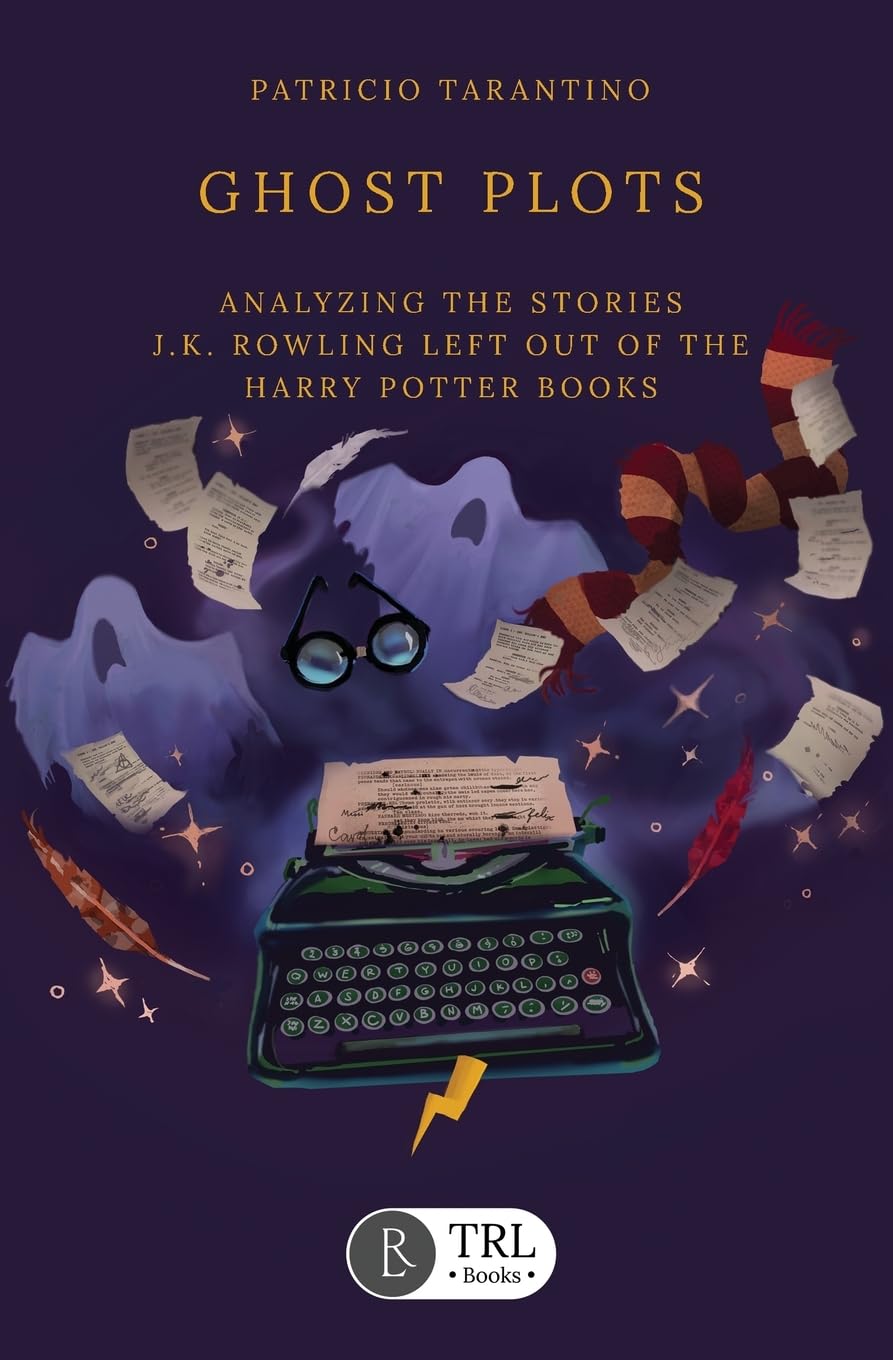 Ghost Plots
 The Phoenix or the Flame
 Secret History of the Wizarding Phenomenon