
TRL Books » The Phoenix or the Flame » Excerpt
The Phoenix or the Flame: Read an Excerpt
- From Dark Dementors to Luna’s Light by Louise M. Freeman
- From Joyce Umbridge to ‘Missy’ Slipkiss by Alice Arganese
- Belated Bellatrix by Irvin Khaytman
- Angry Harry Potter and the Pointless Prophecy by Asher Scheiner
- The Phoenix and the Flame by Beatrice Groves
- J.K. Rowling’s Phoenix ‘Ring Within a Ring’ by John Granger
- The Grid as a Fundamental Clue by Patricio Tarantino
From Dark Dementors to Luna’s Light
When Harry Potter and the Order of the Phoenix was published in 2003, both favorable and unfavorable reviewers agreed: compared to the previous four novels, the storyline had become notably darker, particularly for a children’s book. Novelist Stephen King (80) describes the book as “quite a bit better” than its predecessors, saying, “The tone is darker, and this has the unexpected—but very pleasing—effect of making Rowling’s wit and playful black humor shine all the brighter.” Reviewer Tonkin says that Phoenix is “a consistently bad-tempered book, in which our troubled hero runs the gamut of grouchiness from ‘growling resentment’ to ‘white-hot anger’ … Combined with its bulk, this atmosphere makes for a fairly downbeat read.” Granger calls Phoenix “the darkest and most disturbing of all the Harry Potter novels” and argues that it is the series’ alchemical nigredo (or “blackening”) volume, as it “details Harry’s near complete dissolution. Every idea he has of himself is taken from him” (“Literary Alchemy” 38).
Phoenix is also unique in being the only one of the seven Potter novels for which Rowling has made some of her original outlines available. Remarkably, these notes suggest a story that was psychologically even darker than the final published novel. The series nigredo began as something blacker than black, and not just because of the death of Sirius.
Five specific changes from the outline to the final text contribute to an overall lighter, less downbeat tone. First, the outline more prominently features dementors. They appear at both the beginning and end of the book, and they, rather than Bellatrix Lestrange,1 are responsible for Sirius Black’s death. Second, Luna Lovegood is conspicuously absent from the outline. As her name suggests, Luna is an illuminating light in darkness; she alone gives Harry some comfort after his godfather’s death. Third, the outline starts Harry’s Occlumency lessons in October rather than January, meaning more unpleasant encounters with Snape and a longer period of failure in that endeavor. Fourth, the outline denies both Dumbledore and the Weasley twins the empowering escapes they had in the finished volume; Dumbledore is imprisoned in Azkaban and the twins are expelled instead of flying to freedom. Finally, rather than having Ron overcome his confidence issues and lead the Quidditch team to victory, the outline has Gryffindor losing the final match and ending the season in defeat. By changing these five elements, Rowling shifted the storyline to better exemplify the positive psychology concept of “learned optimism,” and therefore promoted Harry’s resiliency rather than susceptibility to despair.
What is learned optimism?
Rather than study how to cure pathologies or reduce misery, positive psychology asks, “What makes life worth living, and how can we build it?” (Seligman, “Flourish” 232). Positive psychology traces its roots to one of the more negative discoveries of the twentieth century: learned helplessness. Experiments by Seligman and colleagues in the 1960s and 1970s showed that a variety of animals, including humans, after exposure to inescapable adverse stimuli (e.g. shock or loud noise) in one setting, would not attempt escape in later situations. This remained true even if relatively simple actions like jumping over a barrier or moving one’s hand could have ended the ordeal. Learned helplessness is now a recognized psychological phenomenon with more than five decades of study, and is useful in understanding both clinical depression and the basic neuroscience of learning (Maier & Seligman).
The opposite phenomenon, learned optimism, would not be described until the early 1990s. From the start of the learned helplessness studies, Seligman noted:
One third of the people who came to my laboratory, people to whom inescapable events were given, never became helpless. …We began to ask the question, what is it that makes some people immune to helplessness? … It turned out that the key was optimism. (Seligman, “Flourish” 232)
The essay continues in the book.
1 For an in-depth look at what Bellatrix’s addition to Phoenix means for the novel, see Irvin Khaytman’s essay in this volume.
From Joyce Umbridge to ‘Missy’ Slipkiss
I“ t was about five years to finish the first book and to plot the
remaining six books, because they were already plotted before the first book was published”, claimed J.K. Rowling in 1999 (The Connection); it has always been clear that one of the most magical ingredients of the Harry Potter series has been the author’s ability to plan out every step of this complex and extremely detailed story.
One of the most obvious examples of J.K. Rowling’s ability to plan out the outline of a book years in advance was released on J.K. Rowling’s website in 2006 and later shown in greater detail during an exhibition organized between 2017 and 2018. These very precious documents show the meticulousness demonstrated by the writer in planning out this extraordinarily complex series of novels.
This essay will focus on the comparative analysis between the characters in the published edition of Harry Potter and the Order of the Phoenix and its outline. The characters, as J.K. Rowling herself stated, are what really makes the Harry Potter books such an incredible phenomenon. Reading Harry Potter is a narrative experience like no other, but what really creates such a strong bond between the Harry Potter series and its fans are the characters. The readers, for example, find in this series of books their ink and paper twins and best friends. The psychological insights of the three-dimensional characters shaped and created by J.K. Rowling are what really allow the reader to experience the narrative adventure par excellence: the Aristotelian mimesis and catharsis.
The complexity of the characters in these novels will be the heart and soul of this essay. By analyzing the characters in Harry Potter and the Order of the Phoenix and by comparing their psychology and attitude in the published book to the characters’ psychology and attitude in the outline, differences between the two texts emerge.
Missing Characters
Firstly, it has become evident that some characters described in the fifth book are missing in the outline. The most obvious examples are Luna Lovegood, Kreacher and Bellatrix Lestrange.
The Lovegood family was mentioned for the first time in Harry Potter and the Goblet of Fire, when Harry and the others are traveling to the Quidditch World Cup (Goblet ch. 6). Luna’s absence from the fifth book’s outline is surprising since J.K. Rowling always showed how much she was looking forward to writing about her. For example, in an interview with Scholastic, the author revealed that one of her favorite moments in the series was “Luna’s first appearance, because I love Luna Lovegood so much and I was looking forward to writing her.” Her absence from the outline is even stranger when one considers that it is possible to find an initial draft of Luna’s character in the description of Lily Moon. The author, in the documentary Harry Potter and Me, showed a notebook in which she wrote down the initial list of Harry’s classmates and among these students Lily Moon was found (List of students in Harry’s year). Years later, on Pottermore, she published this complete list, and she commented about this character: “First intimation of Luna Lovegood, this name was never used, but gave me an idea for a fey, dreamy girl. She was named before I decided on Harry’s mother’s name” (“The Original Forty”). Thanks to this piece of information, we know that the writer had been thinking of Luna’s personality since the preliminary stages of plotting the series. Despite all this, Luna Lovegood is completely absent from the outline, which makes it quite different from the published edition where Luna is an essential character. Luna’s absence is in some way linked to her father’s absence. However, even though the Lovegood family is not present in the outline, J.K. Rowling shows that even in these early stages of plotting this book, she was already developing the idea of an alternative newspaper opposed to the Daily Prophet. In the outline the author wrote down that “Rita comes out for Harry in ‘The Questioner’” (C24). This The Questioner is clearly the ancestor of Xenophilius’s magazine The Quibbler.
The essay continues in the book.
Belated Bellatrix
If one were to rattle off the most significant antagonists in the
Potter series, the runner-up slot after Lord Voldemort would belong to none other than Bellatrix Lestrange. The wicked witch seems absolutely indispensable to Harry’s story: between killing Sirius Black, teaching Harry about Unforgivables, harboring a Horcrux, and providing an impetus for Neville to evolve, she proves integral to the story. So it’s somewhat puzzling that Bellatrix does not make an appearance in Jo’s early outline for Order of the Phoenix: how could the story have happened without her?
There can be no doubt that Bellatrix would have come to the fore eventually in the series. Her introduction in Goblet of Fire was simply too dramatic, and her role as Neville’s nemesis too significant, to have never amounted to more than another faceless Death Eater among the Averys and Mulcibers of the organization. In a memory that is ostensibly about both Barty Crouches, Bellatrix steals the scene:
The Dark Lord will rise again, Crouch! Throw us into Azkaban, we will wait! He will rise again and will come for us, he will reward us beyond any of his other supporters! We alone were faithful! We alone tried to find him! (Goblet ch. 30)
Every time the Death Eaters come up in Goblet of Fire, Bellatrix is specifically mentioned. Sirius refers to her when listing Death Eaters (ch. 27). Voldemort corroborates Bellatrix’s words during his resurrection:
The Lestranges should stand here. … They were faithful. They went to Azkaban rather than renounce me … when Azkaban is broken open, the Lestranges will be honored beyond their dreams. (Goblet ch. 33)
Sure enough, the promised Azkaban breakout comes in Order of the Phoenix – Jo had done too much buildup to write otherwise. However, in the original drafts, the breakout was meant to happen in May, immediately preceding the Battle of the Department of Mysteries.
Even with that planned breakout on the books, Bellatrix still had no particular role to play beyond being among the Death Eater forces opposing Harry and his compatriots. The breakout would likely have served as a further extended introduction to Bellatrix, by having her among the ranks of the Death Eaters, and then allowed her to come into her own as an antagonist in the last two books.
We are going to explore what precipitated Bellatrix’s earlier arrival and heightened importance in Order of the Phoenix, and see how disparate story threads evolved once she did show up.
Wanted: Sirius’s Killer
Apart from everything else, the existence of the Phoenix outline and the subsequent departures from it illustrate one very important point: Jo is not beholden to her planned chiastic structure when she’s trying to tell a good story. We see this in Bellatrix’s role in the published Order of the Phoenix, when she is nowhere to be seen in Prisoner of Azkaban, and in the way Bellatrix replaces elements that were introduced in Book Three and meant to return.
Most dramatically, of course, Sirius was meant to meet his doom at the hands (or mouths) of dementors, rather than dueling his sadistic cousin.
Much as in Prisoner of Azkaban, dementors were intended to be an important antagonistic force for Harry to struggle against in Book Five’s climax. This is seen in the outline, where Harry’s Thestral flight to the Ministry is “pursued by Dementors” (A26). This, of course, would also be a callback to the beginning of Order of the Phoenix, where Harry has to fight off a dementor in the first chapter (something that is present both in the outline [C1] and in the published book [Phoenix ch. 1]). It also would be fitting, in a book where Harry struggles with trauma and …
The essay continues in the book.
Angry Harry Potter and the Pointless Prophecy
After J.K. Rowling first released some notes of a rough outline of Harry Potter and the Order of the Phoenix, diehard fans had a field day going through it and cataloging differences between the outline and the final published book. Many people took great interest in how the names of Dumbledore’s Army and Order of the Phoenix were originally swapped, how Luna Lovegood is entirely absent from those notes, and how Dumbledore was originally supposed to be imprisoned in Azkaban. But when more of the outline1 later became available, the part that most intrigued me was just two words, both of them “Dumbledore” (C10; A30). Most of the other aspects of the outline were coupled with some explanatory text, for example: “Ginny – cheeky and funny” (C4); “Snape not present – hint why” (C4); “Hagrid still with giants” (C7). However, in two places, the outlines for what were once chapters 10 and 30, the word “Dumbledore” stands alone, almost naked, with no explanatory text. I wondered as to what events these referred and to why J.K. Rowling omitted those events. After a careful analysis, I came to the conclusion that these two “Dumbledore”s hold a hint to a solution to one of the greatest mysteries and frustrations of the original series: What was J.K. Rowling’s primary point and purpose of the plot of Order of the Phoenix, and what was the purpose of Order of the Phoenix’s plotline in the series as a whole?2
It is no secret that Phoenix is constantly rated one of the series’ least liked books.3 There are two primary reasons one can find online for this. The first is that the book is depressing. Melissa Anelli of The Leaky Cauldron, in her book Harry, a History describes how she felt reading Phoenix for the first time: “[Harry] had turned into someone I had little interest in spending eight hundred more pages with. … it was as though dementors had sucked the happiness out of the book” (163). She’s not the only one who feels this way. Emerson Spartz of Mugglenet also rates Phoenix as the worst book, calling it “depressing” and “a real downer” (Spartz and Schoen 147).
The second reason the book is disliked is that Phoenix seemingly does little to advance the series plotline as a whole. Emerson Spartz calls it “the worst anticlimax in the series” (148). Both Dumbledore’s Army and the Order of the Phoenix as a concept play little to no role in the final battle of Deathly Hallows. Voldemort merely reveals himself again (something that could have been done at the end of Goblet of Fire with little damage to the main plotline, saving us upwards of eight hundred pages), and Phoenix’s primary plot, the prophecy that Dumbledore tried to hide from Harry and Voldemort all these years, ends up being primarily a MacGuffin — there to drive the plot along but revealing no new information — as we already knew that Harry had to be the one to kill Voldemort!
A comment on Reddit puts it best:
As a kid, after I read the book for the first time, I remember asking my friends what the “big weapon” was and was very disappointed to learn it was just the prophecy. Especially since them trying to kill each other seemed like the foregone conclusion for the finale of the books. Voldemort had already heard half of the prophecy and it doesn’t seem like not hearing the rest altered his “kill Harry” plan. Overall, the 5th book didn’t move the plot of the series along much. I kind of think she didn’t have any better ideas but it was too late to change the one …
The essay continues in the book.
1 I use outline for the published grid outline of Phoenix, and I use original plan for Rowling’s supposed first outline of the series as a whole.
2 I use plot to describe the internal storyline of an individual book like Phoenix (as distinct from the early outline manuscript of it) and plotline to describe the series storyline of all seven books.
3 It shares this distinction with Chamber of Secrets. This is the general impression I get browsing Reddit (see “What’s your least favorite”) and other fan sites. For what it’s worth, Spartz and Mugglenet in their Harry Potter Should Have Died (150) also rate Phoenix as the worst book, slightly worse than Chamber of Secrets.
The Phoenix and the Flame
Name changes are a significant part of the writing process. As Colin Burrow (17) has argued, “when we meet a name that just seems right … a peculiar magic happens that is related to aesthetic pleasure: the instance both modifies and validates the invisible conventions that we didn’t know we knew.” Dickens, for example, ruminated on his names for some time – the eponymous hero of Martin Chuzzlewit was variously dubbed Sweezleden, Sweezleback, Sweezlewag, Chuzzltoe, Chuzzleboy, Chubblewig, and Chuzzlewig before Dickens hit on the name by which he is now known. Some of J.K. Rowling’s characters have gone through Dickensian-sounding name changes (such as Hedwig, who was originally Kallicrates and then Widdicombe1) and these discarded names may lurk for decades in her head. A name she did not end up using for a Defence Against the Dark Arts teacher, for example (who appeared in her first notes as “Oakden Hernshaw” or “Oakden Hobday” [Lists of Hogwarts subjects and teachers]) reappears nearly thirty years later as Carl Oakden in Troubled Blood. Rowling has noted how fundamental the correct naming, and hence name changes, are to her writing process: “names are really crucial to me, and some of my characters have had eight or nine names before I hit the right one. And for some reason I just can’t move on until I know I’ve called them the right thing – that’s very fundamental to me” (The Connection).
In The Order of the Phoenix outline there is one example of a change in the designation of a character which is not a name change, as such, but which likewise illuminates the author’s writing process. Rowling does not change the name of James Potter when she gives Occlumency lessons the heading “Snape/Harry/Father,” but calling James “Father,” (or, in one heading, “Dad”) while Snape and Harry are both given their names, means that James is referred to only through his relation to Harry. This is something that Shakespeare also did in his first drafts, indicating the way in which minor characters are perceived by the author in relation to the main characters. We have no such treasure trove for Shakespeare’s craft as a handwritten outline, but early printings of his plays have been scoured by critics for evidence of anomalies in the underlying manuscripts which might provide clues for some of Shakespeare’s own first thoughts. In the case of the second printing of Romeo and Juliet – The Most Excellent and lamentable Tragedie, of Romeo and Iuliet, printed in 1599 – this can be seen by the variable speech prefixes of Juliet’s mother Lady Capulet. In the Folio she is designated as “Lady Capulet” throughout, but in the second quarto she is “Old La[dy]” and “Mo[ther]” (sig. B4v–Cr). These unstable speech prefixes appear to record Shakespeare’s own creative process in thinking of Lady Capulet in relation to Juliet, just as Rowling’s “Father” and “Dad” indicates that she is thinking about James through the lens of his relation to Harry.2
The most significant name change between the planned outline for Order of the Phoenix and the published novel is, however, that the name “Order of the Phoenix” originally belonged to the teenage resistance group (Harry’s league against Umbridge) while the adult group was known as “Dumbledore’s Army.” Each of these aspects of the plot are given their own column (with the headings “DA” and “O of P”/ “OP”) and the “DA” column stipulates that at 12 Grimmauld Place, Dumbledore’s Army “Meet for first time” (C4). Conversely, in the “OP” column the first entry occurs much later in the novel, when the “Idea for Order of the Phoenix” first arises (C12). This swapping of the designation of the teenaged and adult groups is particularly striking because Rowling has dated her work on the outline to 2001–2002, thus placing it after the unveiling of the book’s title in 2000.3 If this dating is correct, it means that the …
The essay continues in the book.
1 This can be seen on Rowling’s first draft of Philosopher’s Stone Chapter 6, where she crosses out “Kallicrates” as the name Harry originally gives his owl, and replaces it with “Widdicombe”, before deciding on the final name, “Hedwig”.
2 Further exploration of changes seen in the outline’s characters can be found in Alice’s essay earlier in this volume.
3 In the History of Magic exhibition, this outline was displayed with wall text attributing a 2017 quote to Rowling, stating that “these plans date from around 2001/2.” In October 2000, Rowling announced that the title was going to be Harry Potter and the Order of the Phoenix (Today Show).
J.K. Rowling’s Phoenix ‘Ring Within a Ring’
My task in this anthology is to take a contrarian approach by highlighting an example of the structural artistry in Phoenix, none of which is part of Rowling’s grids A, B, or C. This makes the point that the much greater effort of her planning that makes the longest Potter novel the work of genius that it is, took place well after her first notes on its skeletal plot sequence. The example I will focus on is Phoenix’s ring-within-the-ring, the Battle in the Department of Mysteries. Let’s talk about the essentials, then, of ring writing.
According to Mary Douglas in her Thinking in Circles (35– 38), a literary ring has seven distinctive features. I have reduced these to four: (1) a story circle latch of beginning and end, (2) a ‘middle’ or story-turn that reflect the beginning and the ending, (3) parallels in chiastic sequence between story characters, events, and dialogue between the story going to the middle point and returning to the latch from it, the so-called ‘turtle-back’ lines, and (4) rings within the story ring. Represented in a diagram it looks like a turtle’s back (see below); Rowling’s preference is for seven-part rings and, if the Potter series is any indication, she may be writing as often as not in an asterisk rather than a traditional ring.
In 2010 I gave a talk to The Group That Shall Not Be Named in New York City at the Samsung Center which revealed this structural artistry inside the Potter novels individually and as a series. I published those lecture notes with attendant graphs and charts as Harry Potter as Ring Composition and Ring Cycle: The Magical Structure and Transcendent Meaning of the Hogwarts Saga. Just as that work built on the insights of Joyce Odell and Brett Kendall, so in the intervening years other Potter Pundits, Rowling Readers, and Serious Strikers have documented the parallelism within Rowling’s work, within her series, even between her series.1
Because the ring structure of Phoenix and its place in the seven-part series ring-asterisk has been in print for almost fifteen years and is still available for easy reference elsewhere, I will not review that here. What follows is the internal ring of the Department of Mysteries battle, all explained in terms of latches, turns, and turtle-back parallels per Douglas. It is assumed that any reader of a Rowling Library anthology, especially a collection of essays on Rowling’s grid charts, is very, very familiar with the plot points of The Order of the Phoenix and would feel insulted by unnecessary explanations of the parallels involved. I have, consequently, stripped this down to the bones.
The several grid charts more or less resemble the final product in story progression. I offer the thesis, however, that in those grids’ not reflecting the chiastic parallels of the book that give it its significant subconscious heft, those charts are only the roughest of sketches of the intricate published novel. I also will argue that Rowling’s “Department of Mysteries” and Harry and …
The essay continues in the book.
1 For a collection of links to that work through the years see Granger, “Ring Composition.”
The Grid as a Fundamental Clue
Ah, the Harry Potter fandom during the years when the books were being published. One doesn’t want to fall into the trap of becoming that grumpy old person who insists that everything was better in the good old days, but it’s undeniable that there was something magical about that era. No, we’re not talking about Hogwarts magic, but rather the magic of anticipation, speculation, and the community that formed around J.K. Rowling’s saga. Would it be possible to sit ourselves in that universe, that moment of the timeline, and theorize what could have happened if the plans for The Order of the Phoenix had leaked at the time, before the release of the book?
It was a time when each day brought the possibility of a new revelation. Especially between the publication of the fifth and seventh books, the wizarding world seemed to be constantly expanding, not just through the pages of the books, but also on the big screen with the film adaptations. Fans lived in a state of constant excitement, alternating between devouring available information and wildly speculating about what would come next.
Social media was still in its infancy, but internet forums were buzzing with activity. Every snippet of an interview with Rowling, every behind-the-scenes photo, every rumor about the next book was analyzed with a fervor worthy of the most dedicated scholars. It was as if an entire generation of readers had turned into a less sinister version of Rita Skeeter, looking for clues and connections in the most unexpected places.
But perhaps the most exciting part of this whole experience was the theories. Based on fragments from the books, cryptic statements from Rowling, and sometimes pure imagination, fans built elaborate hypotheses about the future of the saga. Some were far-fetched, others surprisingly accurate, but all were a testament to how deeply readers had immersed themselves in the world of Harry Potter.
One theory, in particular, was etched into my personal memory.1 Long before the publication of the sixth book, when we were still trying to process the events of the Department of Mysteries, a bold idea emerged: Harry had a fragment of Voldemort’s soul inside him. This theory was based on a series of clues scattered throughout the books, but one of the most convincing came from The Chamber of Secrets. In that book, when Harry sees Tom Riddle’s name, he feels a strange familiarity, as “as though Riddle was a friend he’d had when he was very small, and half-forgotten” (Chamber ch. 13) In hindsight, this connection seems obvious, but at the time, it was a shocking revelation.
The theory went further, connecting dots that seemed unrelated: Harry’s ability to speak Parseltongue, his mental connection with Voldemort through dreams, even the way Voldemort’s wand reacted in the graveyard at the end of The Goblet of Fire (ch. 34). Although some of the evidence presented might not have been entirely correct or relevant, the final conclusion turned out to be astonishingly accurate.
These types of theories weren’t just a hobby for fans; they also seemed to have an impact on the author herself. J.K. Rowling has admitted on several occasions that some people had guessed or come very close to guessing the end of the saga: “They have such fun with their theories ... and it is fun, it is fun. And some of them even get quite close” (BBC Newsnight).2 This statement raises a fascinating fact: Rowling read internet theories. The idea of the author browsing fan forums, perhaps laughing at some far-fetched theories and nervously biting her nails at others that were surprisingly accurate, adds an additional layer of fun to the whole phenomenon.
However, the theories that were correct were not the norm but the exception. Most of them were fabrications that never came true — which was logical and natural, given how many …
The essay continues in the book.
1 I can’t find this specific theory now, but see “Harry and Voldemort”, Harry Latino for an example of a similar post.
2 In this same interview, prior to the release of book five, J.K. Rowling was directly asked about Snape having had a crush on Harry's mother, something that wouldn't be revealed until the final book.
 Amazon
 Waterstones
 Foyles
 Barnes & Noble
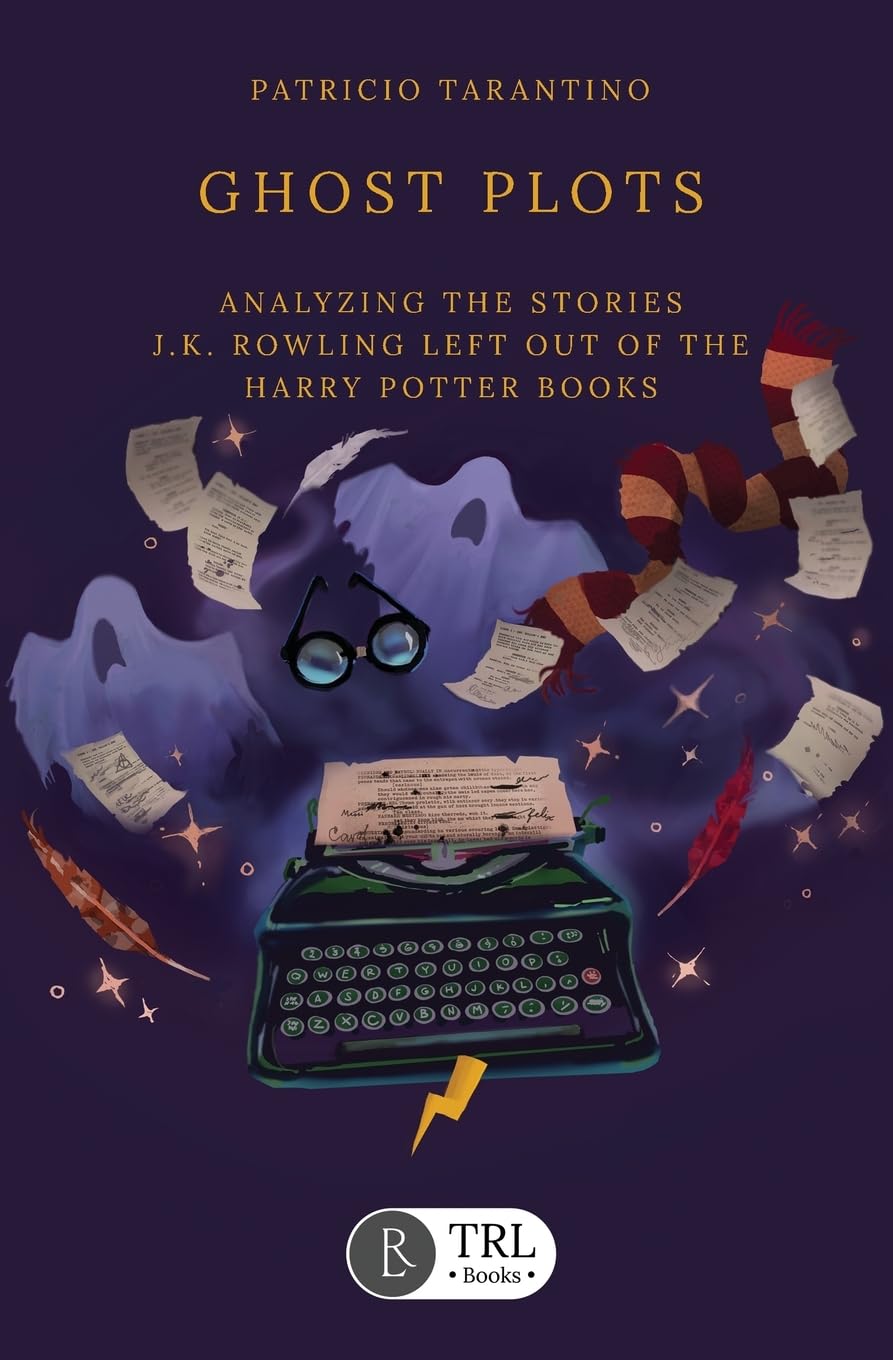 Ghost Plots
 The Many Faces of Harry
 Secret History of the Wizarding Phenomenon